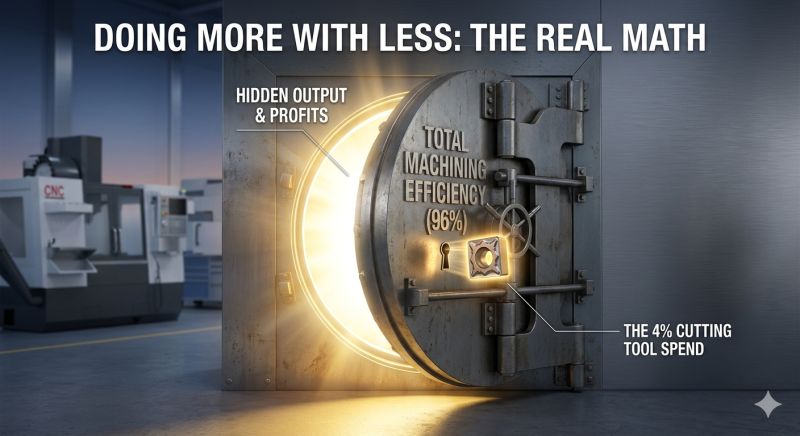
We fixate on their purchase price because it’s the most visible number in the building. But cutting tools sit at the bottom of the cost stack. Machine amortization takes ~26%. Cutting fluid, overhead, maintenance — each around 12%. Delays, 10%.
The tool is cheap. The decisions around the tool are expensive.
Choose the wrong insert geometry and your cycle time balloons — that’s machine amortization going up. Run conservative feeds and speeds because you’re not sure what the tool can handle, and you’re leaving capacity on the table. Pick a tool that wears unpredictably, and you’re either changing inserts too early (wasting money) or too late (scrapping parts and burning machine time).
Here’s a practical example. Say you’re running a job with a 4-minute cycle time, 60 parts per insert. You switch to an insert that costs 40% more but drops the cycle to 3.2 minutes. Over a shift, you go from roughly 100 parts to 120 parts. You spent maybe $15 more on inserts but made 20 more parts. At even $10 margin per part, you just turned $15 into $200.
That’s a 1,200% return on the incremental tooling spend — before you even factor in reduced scrap, fewer unplanned stops, and better surface finishes that eliminate downstream operations.
Shops can boost output 15-25% without a single new machine — just by rethinking tooling from a total-cost perspective.
So why doesn’t everyone do this? Because the math requires data most shops don’t have. What’s the optimal speed and feed for this specific tool, in this specific material? What’s the realistic tool life at those parameters? Too many shops still run on tribal knowledge — the feeds and speeds someone figured out a decade ago, from a programmer who has since retired.
That’s exactly why MachiningCloud is built around verified cutting parameters from 70+ manufacturers across 1.5M+ tools — so programmers start from real data, not guesswork. It doesn’t make the decision for you, but it gets you in the right neighborhood fast.
Next time your team brings a tooling cost reduction initiative, ask one question: are we optimizing the 4%, or the 96%?
Source: https://www.linkedin.com/feed/update/urn:li:activity:7452050043374706688/