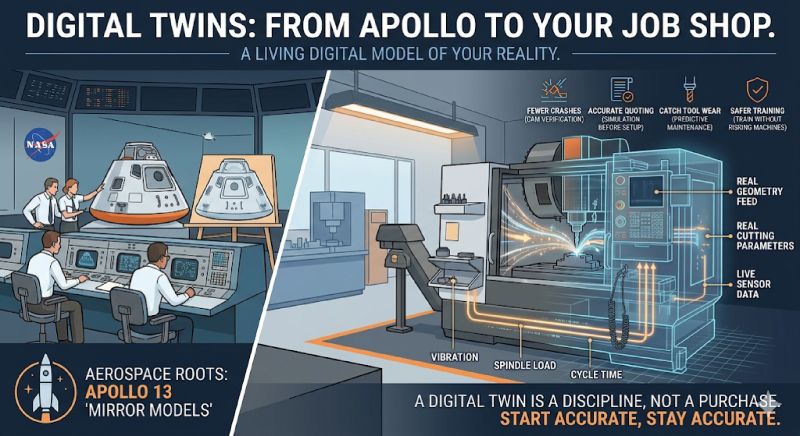
The idea traces back to NASA. When Apollo 13 went sideways, ground-based mirror models were how engineers brought the crew home. Aerospace formalized it because the cost of failure was measured in lives. For everyone else, it looked like overkill.
Three things changed that.
First, the data exists now. A twin is only as honest as the data feeding it — and for a shop, a huge chunk of that “reality” is your tooling: real geometry, real cutting parameters, the right holder. For years that lived in paper catalogs and an outdated spreadsheet. Closing that gap is a lot of what MachiningCloud focuses on — you can’t simulate what you can’t accurately describe.
Second, simulation got cheap. Your CAM system can verify a toolpath against an accurate machine model before a single chip flies — failing safely in software instead of expensively in steel.
Third, the machines got chatty. Modern controls stream spindle load, vibration, and cycle data, so the loop closes: the real machine teaches the model.
For a normal shop, this isn’t a moonshot. It’s accurate digital tools and machines, simulation before every setup, then feeding real results back in. The payoff is concrete: fewer crashes, quoting by simulating instead of guessing, catching tool wear before it ruins your best part, training a machinist before they touch a six-figure machine.
One honest caveat: a digital twin isn’t a purchase, it’s a discipline. A twin fed stale data is worse than none — it gives false confidence. Start small, stay accurate, and it compounds.
Aerospace didn’t build these first because they were smarter. The stakes forced the discipline. That cost has now dropped to where the rest of us can’t afford to ignore it.
Source: https://www.linkedin.com/feed/update/urn:li:activity:7468789449531846656/