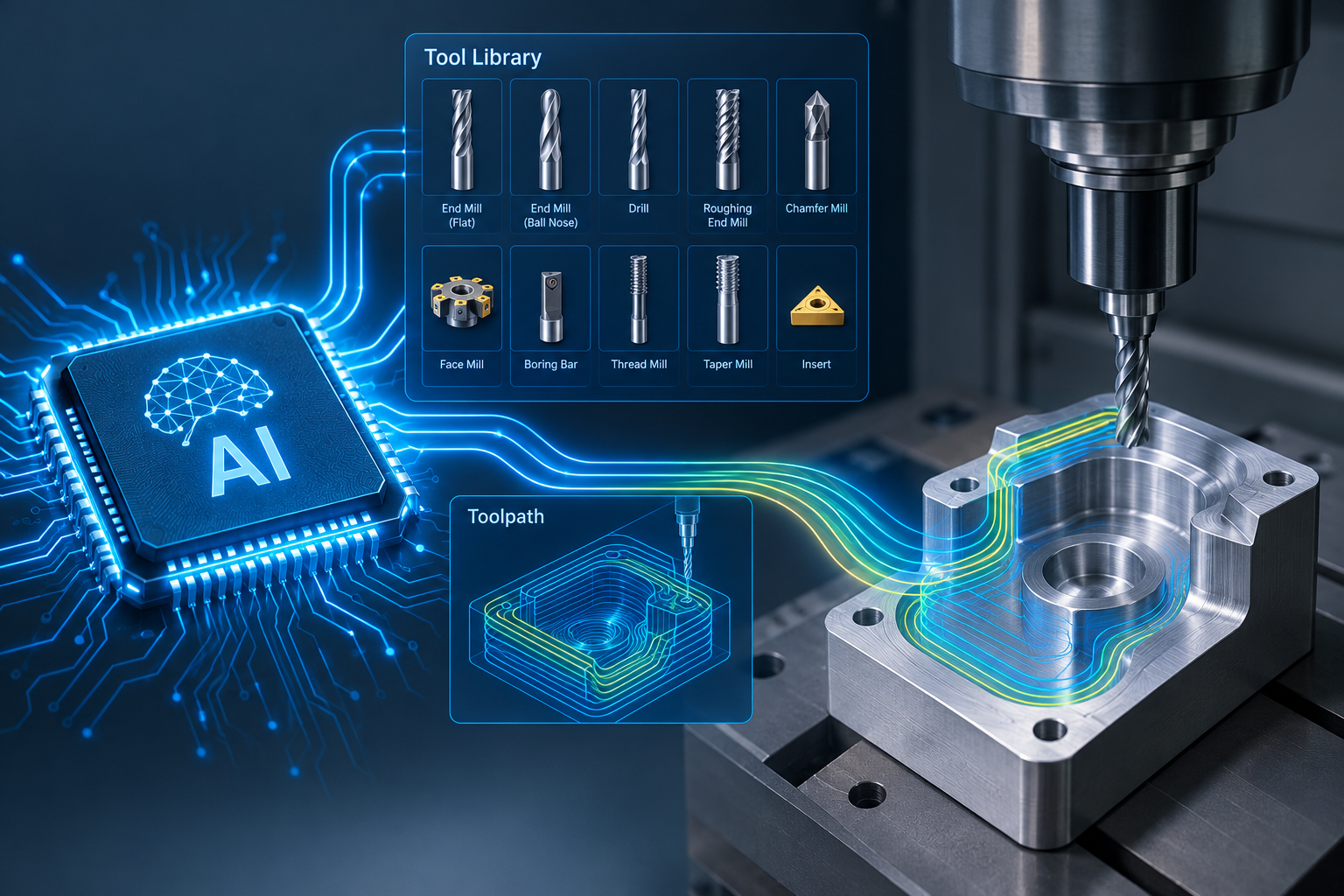
In August we asked a simple question: what is actually working with AI on the shop floor? A month later, IMTS 2026 gave a clearer answer than the industry has had in years.
AI is no longer a slide in a keynote. Software and control makers such as Hexagon, Autodesk and Heidenhain showed AI features that automate programming tasks and reduce dependence on a few experienced programmers. A dedicated Industrial AI Arena with 32 exhibitors focused on specific problems: quoting, work instructions, ROI analysis and process setup.
That is real progress. But there is a catch that rarely makes it onto the booth banner.
AI doesn’t know your tools. Your tool library does.
When an AI-assisted CAM system suggests a roughing strategy, it is making decisions based on the tool you give it: diameter, flute length, corner radius, number of teeth, holder shape and the cutting data behind it. When it checks for collisions, it relies on the 3D model of the assembly.
If that information is wrong, the AI doesn’t hesitate. It produces a confident, well-optimized toolpath for a tool that doesn’t exist in your spindle. Common examples:
- A cutter typed in by hand with a 12 mm flute length when the real one is 10 mm.
- A generic holder shape that is narrower than the actual holder, hiding a collision.
- Cutting data copied from an old job for a different material grade.
- A gauge length that changed after a tool was reassembled but never updated in CAM.
A human programmer with 30 years of experience might catch these mistakes. AI built to replace that experience usually won’t. The less experience in the loop, the more the data has to be right.
Why this is a skilled labor problem too
Much of the case for AI in programming rests on the skilled labor cliff: experienced programmers are retiring, and their replacements need tools that make up for the experience they don’t yet have.
But retiring experts take more than programming skills with them. They also take the “tribal knowledge” stored in spreadsheets, notebooks and personal tool libraries. If that knowledge isn’t moved into a clean, shared, digital tool library, the AI starts from a weaker base than the person it replaced.
Three steps to make your shop AI-ready
- Replace hand-built tools with manufacturer data. Use verified geometry, 3D models and cutting data supplied directly by the tool makers.
- Build complete assemblies, not just cutters. Holder, extensions and stick-out all matter for collision checks and stability.
- Use one library everywhere. CAM, simulation, presetting and the machine should all read the same definition, so what the AI plans is what the machine runs.
MachiningCloud gives you that foundation. It provides product data from leading cutting tool and workholding manufacturers, lets you build assemblies, and exports them to the CAM and tool management systems your AI features run on.
AI will keep getting smarter. Make sure the tool data it relies on is just as accurate.